

Modding Frustration

Recently I began modding a few cars and have been going slow and doing it step by step. I always race and time the cars stock with graphite before I mod them to see if they get faster. Recently I modified a car and it got slower? Here's the list of things I did.
Added 5g of rear centric weight.
Polished the axels.
Sanded the wheels.
Sanded and polished the contact point of the back of the wheel to the chassis.
Glued the axels securely (evenly spaced)
Sanded the bottom of the car flat and smooth.
Painted the car and clear coated it.
ISPxGraphite blend lubed the axels.
I ran the car a dozen times after I was done and somehow it seemed like it got slower ????
Is there times that cars just get slower when you disrupt their stock state?
Discussion

Please don't feel discouraged; you're just getting started in modding. Now you have become an amateur physicist by default, searching for elements to understand and then refine in performance
There will be times when you find that blister fresh GEM of a casting that appears to need little help at all on the track!
- Appreciate it, I've found a few cars straight out of the blister that with a really good ispg lube it absolutely fits all my cars. I'm not discouraged just irritated that I followed the proper steps and yet it slowed down ???? back to the drawing board! — DRIFT_or_DIEcast_Racing
- Look into tungsten sulfide powder as an alternative to plain graphite, see how that works for you — Chris_Hood

Yep. If any of your wheels have a wobble or a buzz and you glue the axles down, it will definitely slow that car down. I usually glue my axles down, but I recently built one where I knew there was a slight wobble, had no replacements, and didn't have much clearance between the inside of the wheels and the chassis so I left them free spinning. It seems to roll better but will see once it hits the track.
- I suppose I can try not gluing the axels down but j feel like gluing the axels down helps proportionate the wheels even so it won't rail ride or bounce off the walls as much assuming it drops fairly square out of the starting gate. It'll never roll perfectly straight but it will spend less time on the wall — DRIFT_or_DIEcast_Racing
- I have been experimenting using auto gasket silicon to glue axles, thinking the little "give" may help. will see — dr_dodge
- Dr Dodge any update on the auto gasket? — Chipped_Paint_Racing
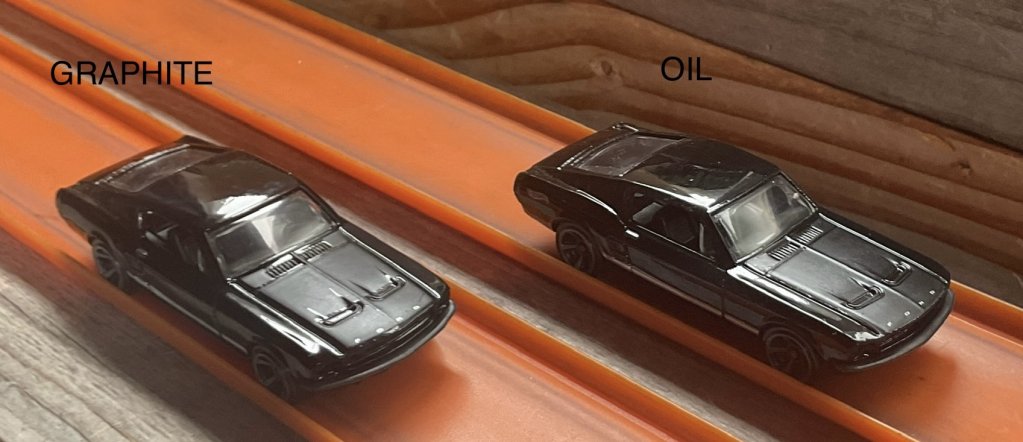

Don't forget that most all of the wheels have a very thin lip that they ride on - which is a feature that is supposed the help the cars roll more easily. I think that sometimes sanding removes that edge and will increase friction due to the increased contact patch.
Another thing is weight placment, I know that a lot of folks prefer a bit of rear bias but that is very casting and track dependent IMO. If you look back at the 2020 Rookie Rally that Brian Vaughn hosted you'll see a track similar to yours. I won that series with a 60g car that had 50/50 weight distribution. Watch the races and you'll see that many times it was beat to the bottom hill but then would overtake cars on the flat section to the finish. It ran very straight and true which I believe was due to its front/rear balance which worked well on that track. Interestingly on the Buckeye Mountain it was only average but on the DragonFire raceway it's one of my top cars.

Lots of good reasons why a car may go backwards which is why I try to build 2 cars for most events so I have a backup choice. Do you check for running straight after your modding? I try to profile a car before working on it including checking for running straight. I then also mark the wheels so I get them back exactly where they were before gluing down. I'm also moving to using E6000 to glue them down with its pretty tough and has some flexibility. Plus you can remove the axels if needed. I only use JB Weld if the car is going t get the crap knocked up it like with jumps etc.
Good luck and keep scratchin' your head like all the rest of us.
Okay, so when you go to pull the wheels out, cut ONLY the one tab--that way the other two tabs will help hold in the wheels. Also, I've found that my faster cars have not had the axles glued in: I just reassemble the with the piece of the interior that presses down on the axles and keeps them in place. I've glued very few axles.
E6000 is my go-to for gluing everything. It's like rubber cement: goes on gooey, dries reasonably hard, but still soft enough to pry out cut apart if need be.
As for lube, try a wet lube. I've actually had surprisingly good results with Slick Liquid, which is a 100% synthetic oil. Just a drop on each wheel, spin it to work the oil in, wipe off the excess, and you're good to go. I use it on my model trains, as well.
Remember, when you are building for an open track or a drag strip, weight placement is different. For drag tracks, you want the weight more towards the rear of the car to help give it a push from slope to gorizontal. For open track, you want more centered in the car, with maybe a slight bias towards the back. I try to do 45/55 on open track, and 40/60 on drag strip cars.
Welcome to your new job as a diecast racing engineer. In this line of work you will constantly be chasing solutions to problems you didn't previously have.
Maybe one wheel is sanded mor or less than another, maybe a wheels has a flat spot, maybe there was a little bit of polish left behind on the an axel and once you add graphite - you get mud, hey maybe an axel is very slighly crooked and the car is now rubbing the sides of the track harder and more often, If the weight placement is not ideal for the drag track it could slow it down depending on the casting. Take the weight out and see what happens. If the car is just a basic mainline, take the wheels out and try a new set and compare the difference. Try putting a polish wheel on medium speed in your preferred rotary tool and spin each wheel several times, but in short burst so as not to overheat the hubs. Maybe that could help clear out anything that maybe be holding back the speed.
Best of luck chasing anomolies and wonkiness :)

Dude! I am the king of making fast cars slow and good wheels bad! Welcome to my world!
- are you on the yellow snow at 905? try harder...lol — dr_dodge
- you got me there Dude! lol — Stoopid_Fish_Racing

Keep working man. It takes a while to get your feet under you. And sometimes you can't make a fast car faster.
Yes. Any of those points could have caused that to happen. I am not a fan of gluing the axels in place, i finds it slows my cars down.